 By Mark
 This post relates to my current work. Although I use the term “privacy protection” it shares many similarities with the “personal information protection” that various companies have practiced for years. However, there is a distinct difference in direction. I have decided to write this from a macro perspective as I found myself thinking, “This is something that requires deeper consideration.” You can view this as a self-reflective piece to confirm whether the direction I am taking in my current execution is correct.
Table of Contents
1. Introduction: AI as a Strategic Asset and the Inevitability of Governance
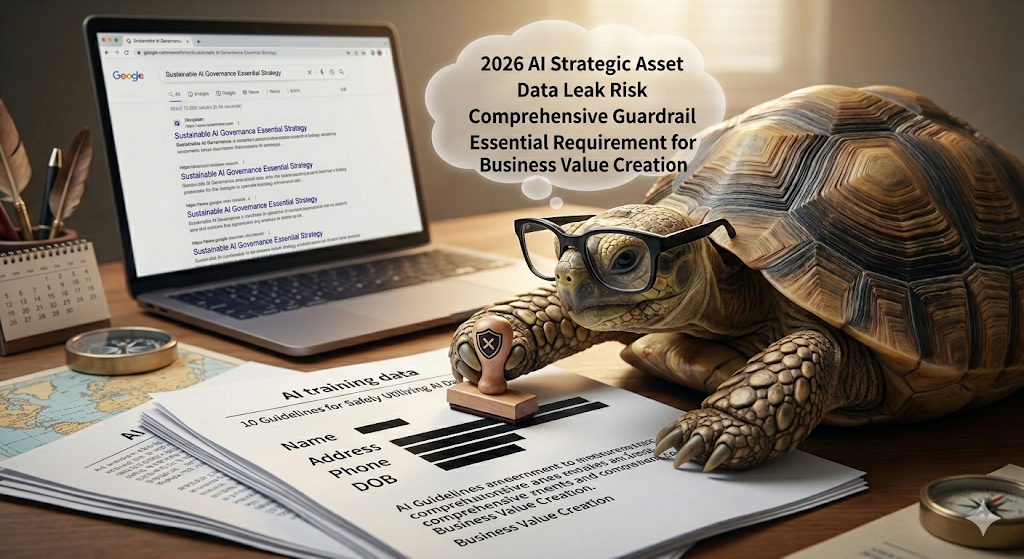
As of 2026, artificial intelligence (AI) technology has fully established itself as a strategic asset that dictates national economic competitiveness, moving beyond its role as a core driver of corporate operations. While data in the past was merely flowing information, modern data is the core capital that determines a company’s survival and the foundation for building high-performance AI solutions. However, this rapid technological leap carries critical risks, such as data leaks (failure of privacy protection), which can cause irreparable losses to a company.
In this context, AI data governance is defined as a comprehensive set of practical practices to ensure data quality, security, privacy protection, fairness, and compliance throughout the entire process—from AI model training to deployment and continuous monitoring. An effective governance system serves as an essential guardrail that not only mitigates risks but also facilitates the creation of high-performance AI that generates business value.
2. Distinction from Traditional Management Systems
While traditional data governance focused primarily on the management and utilization of data, governance in the AI era must reflect the unique characteristics of how AI models consume data and generate new results. Its purpose is to guarantee the accuracy and reliability of models and to promote social fairness by alleviating inherent biases in training data. Given that AI systems often process vast amounts of sensitive information, robust security and privacy protection controls are core components of this governance.
3. Core Components and Expected Effects of AI Data Governance
To establish a trustworthy AI strategy, organizations must not dismiss governance as a task solely for the IT department. A strategy lacking governance can lead to severe consequences, such as fines for regulatory violations, data breach incidents, and reputational damage due to biased results. Therefore, establishing a multi-functional ownership structure that spans HR, compliance, and business teams is the first step toward internalizing governance.
4. Five Core Elements of Governance
The following governance components are essential for building a successful AI system:
- Data Quality Standard Protocols: These protocols check for accuracy, completeness, and consistency to improve model reliability and reduce “hallucination” phenomena.
- Bias Detection and Fairness Testing: These involve testing model outputs by demographic group to ensure adherence to social ethics and prevent discrimination.
- Data Security and Privacy Protection: Techniques such as pseudonymization, anonymization, and access control (ACL) are used to prevent personal information leaks and ensure regulatory compliance.
- Data Lineage: This involves mapping the process from data generation to consumption to ensure model debugging and audit traceability.
- Continuous Monitoring: This monitors for model and data “drift” to maintain real-time performance and prevent security incidents.
AI models trained on low-quality or incomplete data produce flawed and unreliable results, which ultimately leads to poor business decision-making and lowered return on investment (ROI).
5. Mechanisms of Data De-identification and its Application in AI Training
The most powerful policy tool for minimizing personal information leak risks during the AI model training process is data de-identification technology. This encompasses Privacy-Enhancing Technologies (PETs) that preserve data value while ensuring individuals cannot be identified within the framework of privacy laws.
Pseudonymization and Anonymization: The Boundary Between Legal Flexibility and Technical Protection
The core of de-identification begins with the clear distinction between pseudonymization and anonymization.
- Pseudonymization: This replaces direct identifiers (e.g., names, addresses) with virtual data, making it impossible to identify a specific individual without additional information. Pseudonymous information is still legally considered personal data and is subject to laws like the GDPR and Korea’s Personal Information Protection Act, but it provides legal flexibility for use in statistical reporting or scientific research without the subject’s consent.
- Anonymization: This is an irreversible process that renders data such that individuals cannot be identified by any means. Anonymized data is no longer subject to privacy laws and can be stored indefinitely and used freely. The ultimate goal of anonymization when constructing AI training data is to reduce the risk of re-identification to a negligible level.
6. Advancement of Privacy-Enhancing Technologies (PETs) and Mathematical Proofs
Modern PETs applied to AI training go beyond simple information masking and utilize sophisticated, mathematically proven mechanisms.
Differential Privacy (DP)
Differential privacy inserts statistical “noise” into a dataset so that the inclusion of any specific individual’s data does not affect the model’s output. This provides mathematically proven privacy guarantees and effectively blocks “verbatim memorization” attacks, where a model memorizes and directly outputs training data.
Federated Learning and Data Minimization
Federated learning is a technique where models are trained on local devices without sending original data to a central server; only the learned weights are shared. This is regarded as a core technology for implementing the principle of data minimization.
Strategic Utilization of Homomorphic Encryption and Synthetic Data
- Homomorphic Encryption: A cutting-edge technology that allows operations to be performed on data while it remains encrypted, enabling analysis results to be obtained without exposing the data.
- Synthetic Data: Virtual data generated while maintaining the statistical characteristics of real data, used to expand training sets without personal information exposure risks. It is highly valuable in sensitive industries where using real data directly is difficult.
7. Korea’s AI Privacy Policies and Corporate Response Strategies
As of 2025, the Korean government has introduced specific legislative frameworks and guidelines for a “Safe AI Era,” which serve as a compass for companies planning and operating AI services.
Major Policies and Special Systems
The government operates the following systems to balance AI industry innovation with privacy protection :
- Prior Adequacy Review System: A flexible system where companies work with the government during the AI development process to establish compliance plans; companies that implement these plans may be exempt from administrative fines.
- Pseudonymous Information Utilization Special Cases: For cases where using original data is essential (e.g., autonomous driving), the “Personal Information Innovation Zone” allows original data to be used in a secure environment after review by the committee.
- AI Privacy Risk Assessment Model: Standard models are distributed to allow for the pre-assessment of risks based on AI use cases, enhancing corporate autonomous security levels.
Furthermore, companies must adhere to 10 major governance principles, such as notifying users of the possibility of AI malfunctions or hallucinations and ensuring human intervention in final decision-making with clear subjects of responsibility.
8. Conclusion: Policy Recommendations for Trustworthy AI
Preventing data leaks and privacy protection in AI development is a complex task that requires redesigning the entire corporate governance system rather than just adopting simple technologies. De-identification technologies (PETs) are the shield during the training phase, while real-time filtering acts as the surveillance network during the deployment phase.
Companies must immediately implement three major strategies:
- Establish Data Lineage by mapping the entire process from data generation to model consumption to ensure transparency.
- Advance access control models beyond Role-Based Access Control (RBAC) to Attribute-Based Access Control (ABAC) and Relationship-Based Access Control (ReBAC) to precisely control who uses data, when, where, and with what authority.
- Actively utilize Regulatory Sandboxes and the government’s Prior Adequacy Review System to resolve legal uncertainties and maintain the momentum for innovation.
Ultimately, only Trustworthy AI with a strong and systematic data governance policy will survive in the market. Policy designs that ensure AI operates safely will become a core competitive advantage for companies.