 By Mark
 During this era of rapid LLM advancement, I recently moved to a new company. A striking observation in both my previous and current workplaces is that no single organization relies on just one specific AI. Instead, individuals are using the AI tools they personally prefer. Because personal AI tools often offer higher quality than standard corporate-issued software, employees are using them to enhance their work performance. This phenomenon—using personal infrastructure for corporate tasks—is known as Shadow AI, mirroring the “Shadow IT” of the past. Given its versatility, I believe Shadow AI represents an even more pervasive and complex challenge for modern organizations.
Table of Contents
Introduction: AI Economic Infrastructure and the Rise of Shadow AI
As of 2026, artificial intelligence (AI) technology has evolved far beyond a mere productivity aid; it is now a strategic asset that dictates national economic competitiveness. While data in the past was simply a flow of information, modern data serves as the core capital for corporate survival and the foundation for building high-performance AI solutions. In the race for productivity, companies are rushing to adopt AI, yet this rapid leap has fostered a new economic risk: the unmanaged use of AI, or Shadow AI.
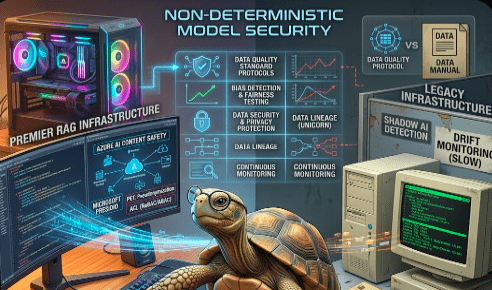
Shadow AI refers to the phenomenon where employees use external generative AI tools, such as ChatGPT, for work tasks without official corporate approval or adherence to security guidelines. This is not just a simple security matter; it is a complex challenge that threatens corporate data governance, potentially leading to legal and ethical liabilities. Because this behavior is becoming a universal norm, effective AI data governance is required to act as an essential guardrail that mitigates risk while facilitating business value. This analysis explores response strategies tailored to organizational size and focuses on human-centric cultural innovation to bring Shadow AI into the light.
1. Economic Threats of Shadow AI and Effectiveness of Management
Simply “banning” Shadow AI often leads to even more clandestine use, increasing overall risk. An AI strategy devoid of governance can result in inaccurate models, regulatory fines, data breaches, and severe reputational damage.
Data Leaks and Reputational Risk
Inputting internal secrets or customer personal data into external generative AI models carries the critical risk of data leaks, which can cause irreparable losses to a company. Since AI systems often process vast quantities of sensitive information, robust security and privacy controls must be core components of any governance framework.
Non-deterministic Vulnerabilities and Management Complexity
A defining characteristic of AI systems is their non-deterministic output. The fact that the same input can yield different results each time means that traditional software security methods are insufficient to control Shadow AI risks. Consequently, rather than relying solely on technical roadblocks, a cultural approach that encourages employees to use these tools safely and voluntarily is essential.
2. Response Strategies by Organization Size: Small vs. Large Organizations
Management approaches to Shadow AI must differ based on the organization’s scale and available resources.
Large Organizations: Multi-functional Ownership and Systematic Governance
Large enterprises and public institutions should internalize governance as a multi-functional ownership structure involving HR, compliance, and business teams, rather than relegating it solely to the IT department.
- Establishing Data Lineage: Organizations must map the process of data from generation to consumption to ensure transparency and auditability.
- Advanced Access Control: Moving beyond Role-Based Access Control (RBAC), companies should adopt Attribute-Based (ABAC) or Relationship-Based Access Control (ReBAC) to secure more precise control over sensitive data.
Small Organizations: Flexible Guidelines and Utilizing Government Systems
SMEs or startups with limited resources benefit from flexible policy responses rather than complex internal systems.
- Utilizing Prior Adequacy Reviews: Smaller firms should use government systems, such as the Prior Adequacy Review System, to establish compliance plans and resolve legal uncertainties during AI service development.
- Adherence to Common Guardrails: Organizations should focus on fostering a culture that respects basic governance principles, such as recognizing and notifying users of potential AI hallucinations or malfunctions.
3. Converting Shadow AI into Official Workflows
To integrate the AI tools employees are already using into official processes, companies must provide “benefits” and “safety” simultaneously rather than just technical enforcement.
Turning AI Guidelines into a “Playground”
Rigid rulebooks often discourage compliance. Instead, providing a “sandbox” environment where AI can be tested safely is more effective.
- Clarifying Responsibility: While experimental use should be encouraged, human intervention in final decision-making must be mandatory to clarify who is responsible for the AI’s output.
- Real-time Feedback Loops: Processes like AI Red Teaming—adversarial simulations that probe for vulnerabilities like jailbreaking or data extraction—should be used to share discovered flaws and educate employees.
Proactive Adoption of Privacy-Enhancing Technologies (PETs)
If external AI is necessary for efficiency, the corporation must provide the technical means to use it safely through PETs.
- Pseudonymization and Anonymization: Companies should encourage the use of pseudonymized data, where direct identifiers like names or addresses are replaced with virtual data. While still legally considered personal data, it offers flexibility for statistical or research purposes without requiring subject consent. Anonymization, which is irreversible, allows for indefinite storage and free utilization as it is no longer subject to privacy laws.
- Real-time Filtering Engines: Frameworks like Microsoft Presidio can be integrated into workflows to detect and mask Personally Identifiable Information (PII) in real-time. The Analyzer Engine identifies the location and type of PII using NER and checksums, while the Anonymizer Engine enforces masking or encryption.
While some might see this as “over-engineering”—a common trait in some high-tech environments—focusing on these two technical areas (PETs and filtering) significantly reduces the burden on security managers and allows them to focus on high-level threats.
4. AI Utilization Tips and Security Governance by Profession
To successfully “onboard” Shadow AI, organizations must provide specific usage guides and security warnings tailored to different roles.
HR and Business Support Teams
- Utilization: Writing job descriptions and summarizing resumes.
- Security Concerns: These teams handle large volumes of sensitive personal data. Security must be strictly enforced using RBAC or ABAC to isolate executive salary data or private personnel records.
- Governance: Output must be monitored for Bias (discrimination against demographic groups) through regular testing and human-in-the-loop oversight.
Marketing and Content Creation Teams
- Utilization: Generating campaign copy and analyzing market trends.
- Security Concerns: These teams are vulnerable to Data Poisoning. Attackers might inject malicious documents into knowledge bases to bias the AI’s responses toward certain brands or provide false information.
- Governance: The copyright and toxicity of generated content should be monitored in real-time using tools like a Content Safety API.
Development and IT Operations Teams
- Utilization: Code completion and system log analysis.
- Security Concerns: Risks include Prompt Injection attacks, where external data is mistaken for commands, potentially leading to the exfiltration of system passwords or manipulation of application logic.
- Governance: Regular AI Red Teaming must be performed to identify logical flaws in models and the potential for guardrail neutralization.
5. Policy Response: Harmonizing 2025 Guidelines and Global Standards
To build Trustworthy AI, organizations should use national policies and international standards as their compass.
South Korea’s AI Personal Information Protection Policy
As of 2025, the South Korean government has introduced specific legislative refinements and guidelines.
- Pseudonymous Data Special Cases: For innovations like autonomous driving where original data usage is essential, companies can use secure environments like the “Personal Information Innovation Zone”.
- AI Privacy Risk Assessment: Companies should adopt standard models released by the government to assess risks by use case and enhance their autonomous security levels.
International Framework: NIST AI RMF
Organizations looking to expand globally should reflect the four core functions of the NIST AI Risk Management Framework in their governance:
- Govern: Cultivate a risk management culture and assign roles and responsibilities.
- Map: Define the AI system’s limitations and identify contextual risks.
- Measure: Quantitatively and qualitatively analyze risks through adversarial testing like red teaming.
- Manage: Prioritize identified risks, execute mitigation strategies, and maintain incident response capabilities.
Conclusion: Redesigning Corporate Culture for Sustainable Trust
The fundamental solution to Shadow AI is not merely the introduction of technology or more regulations. It is a complex challenge that requires redesigning the entire corporate governance framework and shifting the cultural perception of security from a “roadblock” to a means of “safe acceleration“. Privacy-Enhancing Technologies (PETs) serve as the shield during the training phase, while real-time filtering acts as the surveillance network for deployment.
Ultimately, the companies that survive in the market are those that possess Trustworthy AI supported by strong, systematic data governance policies. A policy design that ensures AI operates safely as a tool to supplement human capability will become a core corporate competency in 2026. Instead of fearing or hiding their use of AI, employees should be given a “playground” where they can exercise their creativity within secure, official guardrails. This is the only sustainable path to bringing Shadow AI into the light.