 By Mark
Table of Contents
Terminal-based AI agents like Claude Code and Gemini Cli drastically boost our productivity by analyzing the context of our terminal workflows, managing files, and automating shell command executions. However, they come with a catch: as development sessions grow longer or codebases get larger, the sheer volume of managed context accumulates. This creates a penalty where massive input token costs are charged on every single turn.

This bottleneck is caused by a compounding cost structure in long-context processing. As conversation history expands, generating even a single-line response requires the model to re-ingest the entire accumulated chat log, retrieved source files, and system prompts.
Operational data from production agents identifies a distinct scaling bottleneck: once the total context window size crosses a specific threshold, only 1.5% of the total tokens consumed are allocated to generating the new response payload, while the remaining 98.5% are consumed by context re-ingestion overhead.
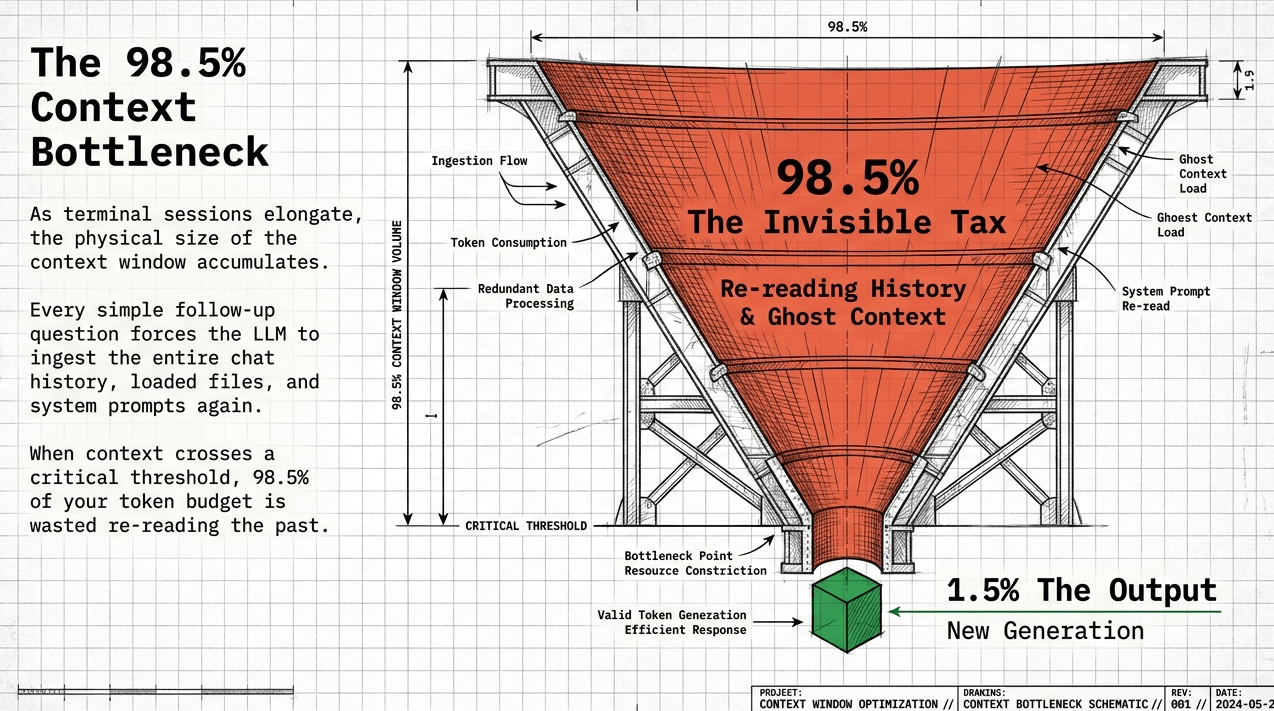
To stop this unnecessary token leakage and maximize the efficiency of your available context window, you need a meticulous software engineering approach and a solid grasp of each CLI tool’s caching behavior. Mathematically, the total token consumption computed during a terminal agent session can be defined as follows:
$$T_{\text{total}} = S_{\text{prompt}} + F_{\text{context}} + \sum_{i=1}^{N} (P_i + A_i) + M_{\text{tool}}$$
Where:
- $S_{\text{prompt}}$ is the static system prompt size required to initialize the agent.
- $F_{\text{context}}$ is the token sum of all active, loaded files.
- $P_i$ and $A_i$ represent the token sizes of the user prompt and the agent’s response at the $i$-th turn, respectively.
- $M_{\text{tool}}$ is the metadata overhead generated from running external tools and interacting with MCP servers.
This report outlines 10 core techniques designed to slash your costs by keeping each of these parameters strictly under control.
Integrated Comparative Analysis of Optimization Techniques
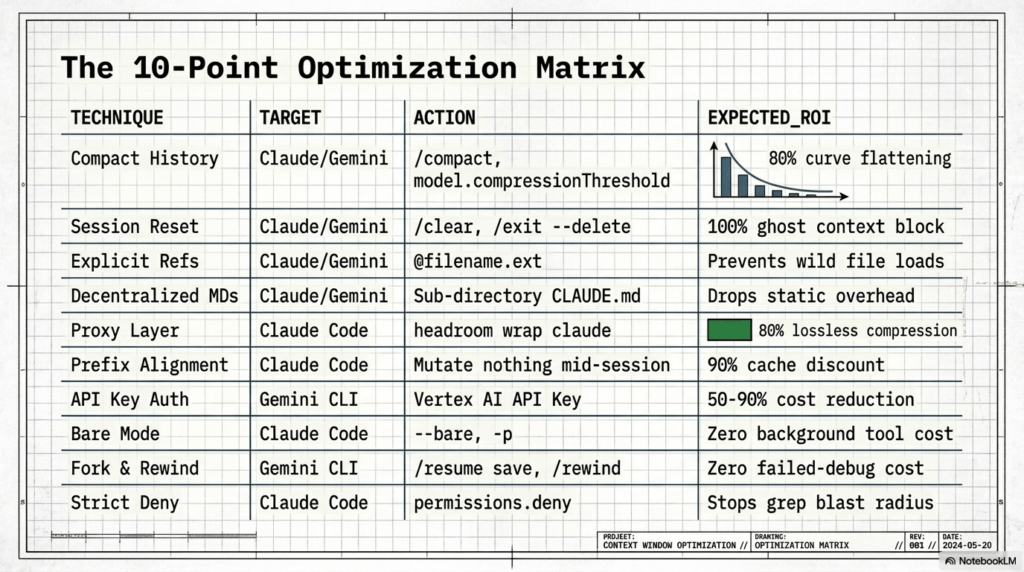
The following table provides a comprehensive comparative analysis of the 10 token and cost optimization techniques covered in this report, broken down by execution parameters, underlying mechanisms, and expected practical benefits.
| Optimization Technique | Target Platform | Available Commands & Configuration Parameters | Core Mechanism & Reduction Strategy | Expected Practical Benefit |
| 1. Proactive Compression & Summarization | Claude, Gemini | /compact, /compressmodel.compressionThreshold | Replaces verbose historical logs with a single, consolidated summary block to neutralize long-term conversation overhead. | Flattens the token consumption curve by over 80%. |
| 2. Session Reset & Forced Termination | Claude, Gemini | /clear, /exit --deletemodel.maxSessionTurns | Physically resets the memory buffer to zero and purges residual temporary files. | Completely cuts off the transmission of “ghost context” from previous sessions. |
3. Explicit @ Reference Injection | Claude, Gemini | @filename.ext, @./directory/ | Blocks the agent’s indiscriminate automated searching (like Grep tools) by injecting only target files. | Prevents unnecessary tool-call metadata and loading of unused files. |
| 4. Guideline Hierarchy Decentralization | Claude, Gemini | CLAUDE.md, GEMINI.md | Replaces monolithic global guidelines with localized sub-directory guides to induce on-demand loading. | Drastically reduces the base fixed cost of prompts sent with every reply. |
| 5. External Proxy Layer Integration | Claude Code | headroom wrap claude | Mechanically compresses large tool outputs and redundant sub-agent responses at the communication layer. | Reduces active data overhead by up to 80% without losing execution integrity. |
| 6. Prompt Caching Alignment Control | Claude Code | (Automatically activated) 1,024 token minimum, 5-min TTL | Ensures exact prefix matching for the first input to maximize Anthropic’s KV cache hit rate. | Deducts up to 90% off input costs for the cached region upon a cache hit. |
| 7. API Key-Based Caching Activation | Gemini CLI | API Key / Vertex AI Authentication, /stats | Bypasses OAuth logins in favor of a formal API key to trigger native system context caching. | Saves 50% to 90% on operational costs when repeatedly querying large codebases. |
| 8. Ultra-Lightweight Execution Tuning | Claude Code | --bare, -p, --print | Skips hooks, skills, MCP servers, and memory searches to enforce one-off pipeline processing. | Completely eliminates background exploration tokens and slashes startup time. |
| 9. Conversation Branching & Restore Points | Gemini CLI | /resume save [point], /rewind | Establishes session snapshots, allowing you to roll back conversation history while preserving file modifications. | Permanently wipes out high-cost, failed conversation history wasted on buggy debugging paths. |
| 10. Strict Deny Rule Design | Claude Code | permissions.deny--disallowedTools | Hard-blocks indiscriminate Grep tool usage or credential source file lookups at the platform level. | Prevents wasteful token consumption caused by exploratory errors and accidental file loads. |
10 Strategies for Token Consumption and Cost Optimization
1. Proactive Context Compression and Summary Control
Context Window Escalation and Proactive Compression
In long-running sessions, the exponential accumulation of response histories and shell execution logs introduces context window inflation and processing overhead. Rather than maintaining an expanded buffer until context window saturation causes degradation, sessions should be proactively compressed upon the completion of a specific task unit.
Implementation Across CLI Agents
- Claude Code (
/compact): The/compactcommand flushes the active conversation log buffer and replaces the historical payload with a consolidated summary text. - Gemini Cli (
/compress): The/compresscommand condenses the active chat history into a single summary message. - Automated Compression Strategy: In
Gemini Cli, this routine can be automated by defining themodel.compressionThresholdparameter within thesettings.jsonconfiguration file. Allocating a value of0.6configures the runtime environment to automatically trigger the compression sequence once context utilization reaches 60% of the maximum allocated capacity.
Data Persistence Framework
To prevent data loss during buffer flushes, critical state variables or technical constraints must be committed to a persistent memory partition prior to compression. Executing the /memory add command migrates the targeted context into a permanent storage layer, such as GEMINI.md, isolating it from the session eviction cycle.
2. Session Control and Forced Initialization
Context Contamination and Session Isolation
Initiating a distinct development task within an existing terminal session introduces severe token overhead. Leftover source code context and debugging logs serve as redundant metadata that contaminates the new workspace and increases operational costs. When switching to an unrelated module or a separate codebase directory, the session context should be initialized using the /clear command to purge the conversation history.
Lifecycle Management and Lifecycle Parameters
Automated Session Ceilings (model.maxSessionTurns): To enforce systematic context limits, modify the model.maxSessionTurns parameter within the global configuration settings. Changing this value from the default unrestricted setting (-1) to a fixed threshold (e.g., 100 turns) establishes a strict operational boundary that prevents indefinite session expansion and unexpected token consumption.
Volatile Session Termination (/exit --delete): For short-term or single-use tasks in Gemini Cli, appending the --delete flag to the /exit command destroys execution artifacts and debugging metadata within local temporary directories, preventing residual data transmission in subsequent requests.
3. Explicit @ Reference Injection
Automated Directory Exploration Overhead
Submitting an engineering task to an agent without defining specific target paths forces the system to programmatically discover the workspace topology. This process executes repetitive automated routines, such as directory listings and deep text searches (Grep), which introduces heavy token overhead and accelerates context window saturation.
Target Binding Specifications (@ Symbol)
To mitigate exploration overhead, exact file paths must be explicitly bound within the prompt using the @ delimiter (e.g., @src/lib/auth.ts). Defining explicit target references suppresses autonomous exploration routines and isolates the model’s execution path to the designated source data, minimizing context buffer inflation.
Source File Size Constraints and Modularization
Injecting exceptionally large source files into the prompt can prematurely exhaust context window capacity. If the runtime infrastructure encounters a source limit exception or performance warning, developers must modularize the target codebase into smaller functional components and reference only the specific sub-modules required for the immediate task unit.
4. Guideline Hierarchy Decentralization and Markdown Optimization
Global Rules Optimization and Ingestion Overhead
Project constraint and rule definition files (e.g., CLAUDE.md, GEMINI.md) function as static session overhead, generating a baseline token expense for every execution turn. For example, a global rules file containing approximately 2,000 tokens infers a recurrent 2,000-token ingestion cost per request, accelerating context window saturation during short or iterative sessions.
Decentralized Rule Configuration Architecture
To mitigate global context inflation, avoid consolidating extensive guidelines into monolithic configuration assets at the system global directory (~/.claude/CLAUDE.md) or the workspace root directory. Guidelines must be decentralized into localized rule files distributed within individual sub-directories or functional modules.
The agent loads these localized instruction files into the execution stack only when operations migrate into that specific sub-directory. This architectural separation excludes guidelines from unrelated packages from the active token calculation, ensuring a lightweight runtime context.
Rule Selection and Pruning Specification
Rule definition files must omit generic engineering advice, such as general code cleanlines standards, which are natively accounted for during core model training. Content must focus exclusively on deterministic architectural specifications, concrete interface constraints, and design patterns unique to the targeted repository.
5. External Proxy Layer Integration
Context Inflation via Protocol Extensions
Integrating multiple Model Context Protocol (MCP) sub-processes, real-time web exploration routines, or autonomous internal sub-agents introduces severe compounding context inflation across the system runtime environment.
Proxy-Based Communication Interception Architecture
To mitigate this payload expansion across the network pipeline, an open-source proxy communication layer (e.g., Headroom) can be deployed as an intermediary between the primary execution agent (Claude Code) and local client invocations. Initializing the session via a runtime wrapper command—such as headroom wrap claude—enables the proxy infrastructure to intercept inter-agent and tool communication.
Packet Compression and Payload Optimization Metrics
The proxy layer algorithmically compresses redundant data packets, verbose tools output logs, and bloated execution artifacts prior to upstream transmission to the Anthropic API endpoint. Operating this intermediary optimization layer reduces the physical token footprint of the aggregate input stream by up to 80% while preserving strict execution integrity and behavioral consistency.
6. Maintaining Perfect Alignment in Prompt Caching Mechanisms
Prompt Caching Alignment and Cache Miss Determinants
Anthropic’s prompt caching infrastructure requires strict, character-level prefix alignment of the static token sequence. Any modification, token mutation, or structural alteration within the defined prefix invalidates the cache boundary, triggering a cache miss and incurring standard full-price computation fees for the entire input stream.
Sequence Preservation and Operational Constraints
- Static Configuration Isolation: To maximize cache hit rates and secure input cost reductions of up to 90%, localized guidelines and root configuration files (e.g.,
CLAUDE.md) must remain completely static mid-session. - Deterministic Ingestion Ordering: Variable or out-of-order source file ingestion disrupts token sequence alignment. File-reading operations and asset reference structures must maintain a strictly deterministic order across execution turns.
Infrastructure Thresholds and Cache Eviction Metrics
- Minimum Capacity Threshold: Prompt caching activates exclusively when the static prefix meets or exceeds a minimum allocation footprint of 1,024 tokens (applicable to architectures such as
Claude 3.5 Sonnet). - Cache Time-to-Live (TTL): The cache partition enforces a strict 5-minute Time-to-Live (TTL) window. If the idle interval between consecutive requests exceeds 5 minutes, the cache expires, requiring full-price sequence re-computation. Development workflows must be structured around continuous interactions within this 5-minute operational window.
Internal State Vector Caching
While internal model thinking blocks cannot be directly manipulated via explicit cache_control headers, they are systematically cached once sealed within prior conversation turns. Rather than terminating sessions prematurely and forcing full context re-ingestion, session summary routines should be utilized to maintain a clean, organized context structure.
7. Adopting API Key-Based Session Authentication
Authentication Architecture and Cache Invalidation
Gemini Cli enforces distinct prompt caching behaviors based on the underlying authentication mechanism. Utilizing OAuth authentication—via standard personal or enterprise Google accounts—routes requests through the Code Assist API infrastructure, which does not natively support prompt caching. This configuration prevents token reuse and increases operational overhead during iterative codebase analyses.
API Key Authentication and Injection Protocol
To enable prompt caching functionality, sessions must be authenticated via a dedicated API key provisioned through Google AI Studio or Vertex AI. The key must be injected as a persistent environment variable within the operational runtime:
Bash
export GEMINI_API_KEY="your_api_key_here"Deterministic Caching and Resource Metrics
When authenticated via the formal API key pathway, the runtime infrastructure systematically references previously accumulated prompt caches during sequential codebase scans and multi-turn interactions. Transitioning to this deterministic API key authentication model suppresses redundant sequence re-computation, reducing input token processing costs by 50% to 90% across sustained multi-turn sessions on identical repositories.
8. Tuning Command-Line Flags for Lightweight Operations
Non-Interactive Task Execution and Initialization Overhead
Launching an agent for structured, single-turn tasks—such as code reformatting, isolated log parsing, or basic text summarization—without restricting background system dependencies introduces significant initialization overhead. Leftover automated subsystem loads generate redundant token consumption and unnecessary processing delays.
Lightweight Environment Configuration (--bare)
To suppress heavy initialization routines, the runtime environment can be restricted by appending the --bare flag upon agent execution. Activating this parameter disables the following subsystem components:
- Automated shell hook detection
- Extension skill injections
- Model Context Protocol (MCP) server synchronization
- Persistent memory loading routines
- Root configuration (
CLAUDE.md) parsing
This restriction isolates the agent to a minimal execution runtime equipped exclusively with standard Bash utilities and a lightweight file editor, eliminating multi-layer startup overhead.
Single-Turn Session Termination (--print)
For pipelines requiring one-off command routing via the terminal interface, the --print (or -p) option must be appended. This parameter enforces immediate session termination following a single inference turn, suppressing background idle scanning routines and preventing subsequent token leakage.
9. Conversation Forking and Micro-Rewind Control
Context Contamination and Failure Bias in Debugging
Prolonged debugging sequences characterized by repetitive execution failures introduce compounding token overhead and context contamination. Beyond the financial implications of serving redundant log payloads, extended exposure to erroneous execution steps generates a structural failure bias within the attention mechanism, escalating the probability of model hallucination in subsequent iterations.
Session State Snapshotting and Forking (/resume)
To isolate failed optimization paths and preserve token boundaries, state snapshotting mechanisms must be implemented during critical architectural transitions.
- State Preservation: Executing
/resume save <snapshot_name>commits the active session state and token sequence to a logical checkpoint. - Non-Destructive Rollback: Executing
/resume resume <snapshot_name>performs a virtual session tree forking routine. This operation truncates the trailing, high-overhead failure logs from the active runtime context while preserving all physical codebase modifications completed on the local storage layer.
Real-Time Inference Interception and State Rewinding (/rewind)
When an execution loop encounters runaway token consumption or degraded code generation quality, the runtime sequence can be intercepted.
Historical Purging: This interception initializes a recovery interface, enabling the restoration of the conversation history to a deterministic state prior to the anomaly, without regressing physical file states.
Inference Interception: Triggering /rewind or issuing a double ESC key sequence forces immediate execution termination.
10. Designing Strict Deny Rules and Blocking Indiscriminate Tool Scanning
Autonomous Exploration and Context Saturation
Operating an agent in autonomous mode via execution flags (e.g., auto, bypassPermissions) can induce uncontrolled iterative exploration routines. When targeting isolated bugs, the autonomous execution loop may execute broad text search chains (Grep) and automated file ingestion (Read) across the entire workspace directory. This unconstrained resource allocation forces massive source code volumes into the active context window, causing exponential token consumption.
Tool Constraint Configurations (--disallowedTools)
To intercept runaway tool execution loops at the infrastructure level, absolute functional restrictions must be enforced via runtime flags or global configuration assets. Injecting the --disallowedTools parameter restricts the model’s available action space:
Bash
# Example syntax to suppress broad scraping and high-risk operations
--disallowedTools "Grep" "Bash(rm *)"
Enforcing these constraints suppresses broad text-matching exploration patterns, preventing the recursive ingestion of large source code blocks.
File Ingestion Exclusions and Permission Boundaries (.claudeignore)
Relying exclusively on file-level exclusions (e.g., .claudeignore) may fail to completely mitigate internal tool execution or shell-bypass patterns due to runtime serialization edge cases. To guarantee data isolation and prevent context leakage, explicit security access boundaries must be hardcoded within the local project configuration directory (.claude/settings.json) utilizing the strict permission denial schema:
JSON
{
  "permissions": {
    "deny": [
      "unauthorized_tool_or_directory_path"
    ]
  }
}
Conclusion & Strategic Recommendations for Optimization
Conclusion and Operational Synthesis
The optimization frameworks analyzed in this report transition token consumption metrics from variable runtime overhead into deterministic, controlled infrastructure assets within Claude Code and Gemini Cli environments. Empirical data indicates that the primary drivers of terminal-based AI agent expenditures are unconstrained conversation log expansion and unrestricted workspace exploration routines.
Operational Maintenance Protocol
To mitigate token allocation anomalies, the system runtime configuration must integrate the following operational maintenance protocols:
- Proactive Buffer Compaction: Session compaction directives—specifically
/compactand/compress—must be executed systematically upon task completion as a preventative maintenance routine, rather than an emergency exception handling measure. - Isolated Source Ingestion: Workspace references must be explicitly isolated using the
@path delimiter to suppress autonomous system-wide exploration and target resource allocation precisely.
Cache Maximization and Access Isolation Governance
- Sequence Alignment Preservation: Achieving the maximum 90% cost reduction supported by prompt caching infrastructure requires strict workflow discipline, including zero mid-session modifications to configuration state assets (
CLAUDE.md) and adherence to the 5-minute Time-to-Live (TTL) interaction boundary. - Access Isolation Governance: For enterprise-scale repository analysis, absolute permission isolation governance must be enforced via explicit denial parameters (
permissions.deny) to block unauthorized file loading routines.
Integrating these systemic constraints with automated communication-layer data reduction mechanisms, such as the Headroom proxy infrastructure, establishes an optimized pipeline that minimizes operational overhead and guarantees strict token efficiency.