 By Mark
 The implementation of honey-tokens within defensive security architectures functions as a tactical deflection mechanism, routing adversarial vector paths toward artificial assets to extend incident response windows. Historically derived from the foundational honey-pot paradigm, this deception architecture has expanded into specialized operational variants, including honey-PCs for physical endpoint simulation, embedded tracking tracking scripts inside honey-docs, and honey-nets simulating entire enterprise network topologies.
While this defensive framework has increasingly integrated into identity and access management (IAM) authentication layers and vector token structures, its practical utility within enterprise production environments introduces distinct operational constraints. Empirical infrastructure deployment demonstrates that traditional deception assets frequently generate low operational returns in standard day-to-day enterprise security operations, showing higher efficacy indicators primarily within specific high-volume, external-facing B2C web service architectures.
Evaluating the structural conversion of this defensive model requires analyzing how these traditional, low-dimensional token mechanics adapt when mapped into high-dimensional AI system runtimes and neural embedding layers.
Working in the cybersecurity industry exposes you to an array of defensive decoys. The concept of “Honey-Tokens” follows this same philosophy—deflecting a hacker’s attention toward an artificial asset to buy precious response time.
Traditional perimeter security architectures and passive, filter-heavy verification models possess structural vulnerabilities in detecting real-time lateral data exfiltration once an initial boundary breach occurs. Reliance on external perimeter defenses introduces a critical blind spot during the containment phase of highly coordinated intrusion scripts, where data staging and exfiltration operations can bypass static signature-based detection. Mitigating this risk requires moving away from reactive human intervention and establishing deterministic, system-wide indicators that can identify internal adversaries independently of broad corporate infrastructure variables or administrative dependencies.
To resolve these perimeter limitations, honey-token injection functions as an internal, active layer of defensive deception engineered to neutralize authenticated adversaries who have successfully penetrated the outer security boundary. While traditional network-layer honey-pots introduce high maintenance overhead and false-positive rates due to systemic noise, modern honey-tokens can be programmatically hardcoded into high-dimensional vector spaces and insulated by difference-calculating guardrail layers.
This mathematical isolation transforms the asset into a deterministic silent tripwire. Because the injected vector token resides entirely outside valid business data structures and production indices, any access or mathematical evaluation of the asset triggers an alert with a 0% false-positive rate. This mechanism ensures immediate threat detection during automated retrieval routines without causing degradation to pipeline search availability, accuracy, or baseline business logic latency.

Series: [The AI Shield] Advanced AI Security and Data Governance Architecture
- System Configuration and Filtering
- Data Engineering and Preprocessing
- Mathematical Optimization and Advanced Defense
- Embedding Noise Injection
- Logical Partitioning
- Embedding Model Bias Verification
- Honey-token Injection (Here!)
Table of Contents
1. The Practical Limits of Traditional Honey-Pots vs. Vector-Space Honey-Tokens
Engineers who have managed production security infrastructures understand why traditional honey-pots—simulated server environments built to lure attackers—frequently fail and end up abandoned in enterprise deployments. To appreciate the value of a vector-space honey-token, we must contrast the structural differences between these two methodologies.
1.1 The Three Structural Failures of Traditional Honey-Pots
- Low-Effort Attacker Detection: Modern Advanced Persistent Threat (APT) actors scan environment variables, monitor network response latencies, and audit filesystem anomalies immediately upon gaining entry. They can quickly identify a synthetic virtualization sandbox and navigate around it.
- The Maintenance Vortex: To maintain a convincing illusion, security operations teams must manually update the configuration, patch levels, and dynamic traffic profiles of the decoy system so it mirrors actual production servers. This administrative burden rapidly drains security engineering resources, leading to configuration drift and eventual decommissioning.
- Alert Fatigue via Automated Scanners: Because traditional honey-pots are exposed to external network segments, they generate an endless stream of alarms triggered by benign web crawlers and automated port-scanning bots. This floods security operations centers (SOC) with white noise, masking legitimate indicators of a targeted compromise.
1.2 The Geometric Decoy: Injecting Inside the Live Index
Honey-token injection avoids the deployment of independent, superficial decoy server instances. Instead, the architecture programmatically embeds synthetic, high-dimensional vector records directly inside the active production vector database index, distributing them systematically among legitimate enterprise knowledge assets.
When an adversary attempts to reverse-engineer proprietary document structures or execute broad exfiltration scripts across high-dimensional boundaries, the retrieval pipeline forces interaction with these fabricated dense vectors. Because the injected honey-tokens maintain structural and mathematical parity with authentic embeddings, automated extraction routines cannot differentiate the decoy assets from production data.
This methodology establishes a deterministic detection mechanism within the existing database schema, requiring zero supplementary infrastructure footprint and eliminating additional administrative configuration overhead.

2. Advanced Vector Data Exfiltration Attack Scenarios
To map out the defensive utility of honey-tokens within AI ecosystems, we must trace how sophisticated adversaries exploit high-dimensional vector spaces to bypass traditional application guardrails.
2.1 Insider Threats and Similarity Extraction Attacks (Oracle Attacks)
Enterprise retrieval pipelines ingesting highly sensitive intellectual property—including proprietary source code, unannounced corporate development documentation, and executive compensation datasets—are vulnerable to adversarial manipulation targeting the non-deterministic nature of semantic search. An internal adversary with legitimate credentials, or an external threat actor utilizing compromised credentials, can navigate around traditional security perimeters by bypassing explicit role-based access control (RBAC) schemas and conditional keyword verification filters.
Because conventional defense mechanisms rely heavily on static substring matching and deterministic blacklists, they fail to intercept queries that omit explicit forbidden terms but maintain high semantic similarity to restricted assets.
The adversary exploits this vulnerability by executing a sequence of highly optimized, iterative natural language prompts designed to align mathematically with the specific high-dimensional vector coordinates of the target data. By formatting requests to extract granular operational attributes through generalized demographic or circumstantial descriptions rather than direct identifiers, the attacker induces the retrieval pipeline to surface sensitive embedded records, achieving unauthorized data exfiltration through standard semantic similarity matching.
2.2 Evading Perimeter Guardrails Through Low-and-Slow Exfiltration
Because the text contains no direct blacklisted keywords, application-layer firewalls and superficial string filters parse the query as a legitimate business analytics request. The request passes unimpeded to the vector database. Inside the vector index, the engine calculates the cosine similarity scores between the query vector and the underlying data chunks.
Due to the mathematical proximity of the semantic concepts, the database returns the confidential executive compensation segments to the LLM, which then formats them into a clean textual summary for the attacker. By executing this low-and-slow strategy, the hacker reconstructs premium enterprise secrets piece by piece via the conversational interface, leaving no traditional high-volume data-dump signatures in the network log.
3. Designing Zero-Impact Multi-Space Routing and Metadata Isolation
The primary architectural challenge when introducing decoy records into a production dataset is ensuring they do not pollute legitimate business operations. Decoy vectors must never surface in an authentic user’s search results, corrupt the context window of the LLM, or degrade retrieval performance. To guarantee absolute business availability, the architecture enforces a strict dual-layer isolation model using runtime metadata filtration and empty subspace targeting.
3.1 Runtime Metadata Isolation with Zero Performance Overhead
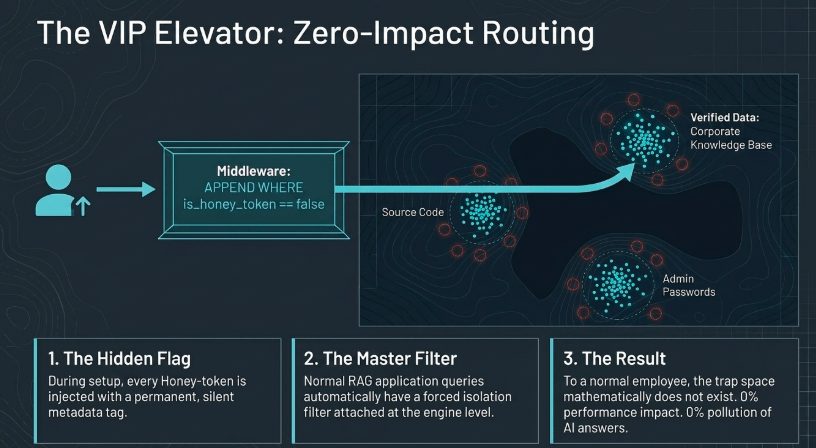
During the data preprocessing pipeline, every synthetic honey-token vector is tagged with an immutable, system-level metadata flag: is_honey_token: true before it is written to the physical index.
When an authenticated, legitimate user submits a prompt to the RAG system, the middleware policy gateway automatically intercepts the request. Before the vector database executes the approximate nearest neighbor (ANN) search, the gateway injects a global system filter directly into the query execution plan: WHERE is_honey_token == false.
[User: R&D Staff] ──> [Middleware Policy Gate]
                             │
                             ├──> (Injects Filter: is_honey_token == false)
                             └──> Route to Vector DB Index (Bypasses Decoy Space)
This ensures that for every standard operational request, the honey-token coordinates are rendered mathematically invisible to the execution engine. Because the database excludes these records during the initial filtering pass of the graph traversal, they introduce no compute latency and zero risk of context contamination for the end-user.
3.2 Hardcoding Targets Inside Empty High-Dimensional Subspaces
If the decoy records are completely hidden from regular search operations, we must define how an adversary inevitably triggers them. The answer lies in the topology of high-dimensional vector spaces and the exhaustive scanning patterns of an attacker.
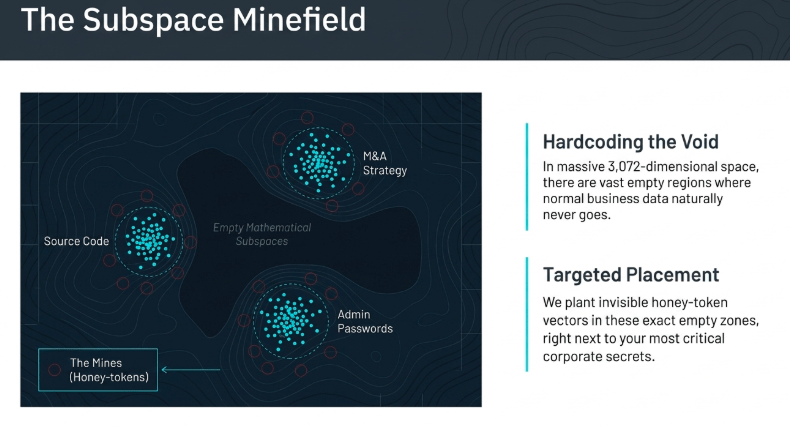
In a massive vector space spanning 1,536 or 3,072 dimensions, there are vast regions where no valid business terminology or semantic sentences ever map. These regions are known as empty subspaces. A security data engineer calculates the coordinates right along the boundary of highly restricted data clusters—such as core algorithmic source code modules—and intentionally maps honey-tokens into these vacant geometric zones.
Put simply: an ordinary user navigating the database via standard semantic queries will never land in these vacant zones. However, an adversary executing an automated oracle attack or attempting an index-wide memory dump must scan across the entire vector topology. The moment an anomalies scanner or an illicit sweeping query touches these vacant coordinates, the trap springs. Malicious actors probing for anomalous entries are intentionally fed anomalous, tracking-infused data.
4. The Mechanics of a Zero False-Positive Silent Tripwire
An adversary attempting an unauthorized database backup or running dense, automated query scripts to map out index boundaries will inevitably call the coordinates of these hidden honey-tokens.
4.1 Definitive Indicators of Compromise (IoC)
While standard Intrusion Detection Systems (IDS) frequently generate false alarms due to user typos or irregular search queries, a honey-token log event operates with absolute certainty. Because no valid business process or legitimate user query path can ever resolve to a honey-token vector ID (e.g., honey_vector_secret_09x), any read or fetch event targeting that ID serves as an absolute, immutable Indicator of Compromise (IoC).
4.2 Maximizing SOC Efficiency via Low-Compute Telemetry
This active defense model completely removes the requirement for resource-heavy behavioral monitoring daemons running across the compute cluster, keeping infrastructure overhead near zero. The security team only needs to establish a simple, passive webhook trigger on the database log facility that alerts the SIEM whenever a honey-token record identifier is accessed.
This completely eliminates alert fatigue for security operations analysts. The moment the tripwire fires, the SOC can immediately extract the attacker’s session token, isolate the compromised API key, and revoke their network route in real time.
5. Global AI Compliance Mapping and Digital Forensic Tracking
Deploying an active decoy framework within a vector index does more than protect corporate intellectual property; it supplies verifiable compliance evidence that satisfies global artificial intelligence data laws.
5.1 Fulfilling Post-Incident Auditing Requirements Under the EU AI Act
The EU AI Act sets strict standards for high-risk AI deployments, including systems used for corporate workforce evaluation and critical business resource allocation. The framework mandates that enterprises maintain robust technical logging mechanisms capable of tracking the root cause, timeline, and scope of data exposure during an incident. ISO/IEC 42001 standards similarly require multi-layered controls for data loss prevention (DLP).
Passive prompt filters at the application layer fall short of proving compliance during a post-incident regulatory audit. Honey-token injection provides unambiguous, engine-level forensic logs that demonstrate exactly when an index breach was detected, how it was contained, and which vectors were targeted.
5.2 Embedding Cryptographic Watermarks for Digital Forensics
The payload of a honey-token can be engineered to contain unique, non-standard text strings or embedded cryptographic watermarks alongside standard tracking strings. If an adversary successfully extracts an index snapshot and attempts to host the stolen intellectual property on an external public service or train a competing model, the presence of these distinctive strings provides irrefutable forensic proof.
[Stolen Data Fragment] ──> Contains: "STR_ID_HONEY_DECOY_99X" ──> Irrefutable Proof of Theft
This allows corporate legal and security teams to mathematically prove the data originated from their proprietary infrastructure, forming a solid basis for intellectual property litigation and regulatory enforcement.
6. Honey-Token Injection Operational Checklist for AI Infrastructure Architects
To deploy a high-speed, zero-false-positive decoy framework inside a production-grade RAG environment without disrupting availability, validate your architecture against the following 10 deployment criteria:
| Control Domain | Implementation & Audit Criteria |
| 1. Sensitive Cluster Scoping | Have you mapped and isolated the vector clusters containing the enterprise’s highest-value IP (e.g., source code, financial roadmaps)? |
| 2. Subspace Coordinate Calculation | Have you calculated and mapped the precise coordinates of vacant high-dimensional subspaces that sit completely outside valid semantic bounds? |
| 3. Immutable Metadata Tagging | Are all synthetic decoy vectors hardcoded with the structural flag is_honey_token: true prior to ingestion? |
| 4. Mandatory Runtime Enforcement | Does the RAG gateway dynamically append a WHERE is_honey_token == false filter to all standard user query execution plans? |
| 5. Decoy Payload Optimization | Is the textual content of the honey-token designed to look highly attractive to an adversary (e.g., sys_admin_backup_passwords.txt)? |
| 6. Cryptographic Watermarking | Have you embedded traceable forensic code strings or unique corporate signatures within the decoy payload text? |
| 7. Real-Time SIEM Integration | Is the vector log analyzer configured to fire a critical SIEM alert immediately upon any read or fetch event targeting a decoy identifier? |
| 8. Stochastic Vector Rotation | Do you run a routine job that injects a slight mathematical variance (noise) to dynamically shift decoy coordinates, preventing attackers from mapping them? |
| 9. Reranker Exclusion Rules | Have you verified that Part 3’s hybrid reranking engine explicitly drops or ignores decoy records to prevent them from hitting the LLM context window? |
| 10. Immutable Write-Once Logging | Are the telemetry logs triggered by honey-token access streamed directly to a tamper-proof, write-once-read-many (WORM) storage vault? |
Conclusion: Active Geometric Traps as the Cornerstone of the AI Shield
The architectural journey we have mapped out across [The AI Shield] series began with screening prompt injections at the outer gate. We then verified semantic factuality via metadata filters and hybrid reranking, established clear tenant boundaries through multi-tenancy isolation and deterministic anonymization, and continuously audited system health using data lineage tracking and embedding model bias verification.
The deployment of Honey-Token Injection completes this multi-layered defensive blueprint. It functions as an active geometric trap that secures the infrastructure from the inside out, neutralizing advanced adversaries who manage to slip past external firewalls. By remaining completely silent during standard operations while functioning as an absolute tripwire against illicit sweeping queries, honey-tokens allow a production RAG environment to achieve authentic zero-trust status. Eliminating defensive ambiguity gives enterprises the structural confidence to accelerate AI innovation, knowing their underlying core data assets are natively secure. Thank you for following along with [The AI Shield] series.
💡 Epilogue: Data Architect’s Practical Engineering Diary
As I compile the final blueprints for this ten-part series, my mind wanders back to my university days as a pure mathematics major. I spent countless long nights staring at abstract proofs in linear algebra and vector calculus, genuinely stressing over whether these ethereal equations would ever translate into a viable career. At the time, the professional outlook for a math graduate seemed confined to academia or standardized test preparation.
Yet standing here, where high-dimensional vector spaces and artificial intelligence pipelines anchor global software infrastructure, I realize those exact foundational concepts—vector space axioms, Principal Component Analysis (PCA), and orthogonal projection matrices—have become my most powerful assets. They provide the precise framework required to analyze and architect zero-trust AI environments faster and deeper than traditional approaches allow. Witnessing those isolated pieces of past academic theory align perfectly with macro technology shifts is the greatest reward an engineer can ask for.
Combining this mathematical architecture with practical infrastructure experience, I am kicking off an open-source initiative to build a standalone Secure Mini-RAG System from scratch. Rather than relying entirely on commercial API platforms, I intend to build a reference prototype within a lightweight, open-source small language model (SLM) environment. This hands-on project will demonstrate exactly how the components we have analyzed—embedding noise injection, atomic bitmask partitioning, WEAT-based bias normalization, and honey-token tripwires—lock together seamlessly within actual production code. I look forward to sharing those repository blueprints and deployment logs with you in the next phase of our journey.