 By Mark
 As a Proof of Concept (PoC) project, this initiative aims to actualize my previous theoretical blog records into a partially functional, production-ready security RAG (Retrieval-Augmented Generation) system. This project was born out of a fundamental question: “We know these security concepts exist in theory, but what is their actual impact, and are they truly necessary in a production environment?”
With advanced AI assistants available at our fingertips, I initially jumped into this thinking, “Hey, implementing this will be a walk in the park, right?” Well… it turns out the limitation was entirely on my part. While it doesn’t achieve absolute, hands-off automation, it successfully reduces pipeline runtime overhead to near-zero compared to legacy approaches.
Conclusively, building a bulletproof security layer for RAG is anything but simple. After restructuring the core architecture three times from scratch, I have finally arrived at a program that reliably boots and processes data.
Series: [The AI Shield] Advanced AI Security and Data Governance Architecture
- System Configuration and Filtering
- Data Engineering and Preprocessing
- Mathematical Optimization and Advanced Defense
Below is the blueprint of the layers and modules I have established to tackle this challenge, which will serve as the roadmap for my upcoming technical series.
Series Title: Bastion-RAG — Enterprise Secure RAG Governance Project
- [Bastion-RAG] Project Security RAG – Here!
- [Bastion-RAG 0] Strategic Alignment: AI-Assisted Architecture Auditing (Architecture Design)
- [Bastion-RAG 1 — Sentinel] Symmetrical Validation Gateway
- Prompt Injection Defense
- Metadata Structural Filtering
- [Bastion-RAG 2 — Vault] Zero-Trust Privacy Shield
- Cryptographic Multi-Tenancy Isolation
- Deterministic Tokenization & Anonymization
- [Bastion-RAG 3 — Navigator] Tenant-Isolated Hybrid Search
- In-Process Cross-Encoder Hybrid Reranking
- Logical Partitioning & Collection Access Control
- [Bastion-RAG 4 — Anchor] Mathematical Embedding Security
- Differential Noise Injection (Inversion Defense)
- WEAT Bias Analysis & Ethical Guardrails
- [Bastion-RAG 5 — Tracker] Non-Invasive Observability Engine
- Real-Time Distributed Data Lineage Tracing
- Multi-Layer Honey-Token Intrusion Detection
- [Bastion-RAG Demo] Interactive Security Scenario Replay Mode

목차
1. The Historical Evolution and Milestones of RAG
Retrieval-Augmented Generation (RAG) emerged as a disruptive paradigm designed to overcome the core limitations inherent to Large Language Models (LLMs): factual hallucination, knowledge cut-off limits, and the structural inability to safely query private, unindexed corporate knowledge bases. The evolutionary trajectory of RAG has rapidly shifted from naive keyword matching to complex, context-aware modular ecosystems.
| Phase 1: Naive RAG | Phase 2: Advanced RAG | Phase 3: Modular RAG |
| Flat Text Chunking | Hierarchical Semantic Chunking | In-Process ML Embeddings |
| Basic Vector Similarity | Hybrid Search (Vector + BM25) | Multi-Agent AI Routing |
| Context Disconnect Risks | Cross-Encoder Reranking (RRF) | Data Governance Layers |
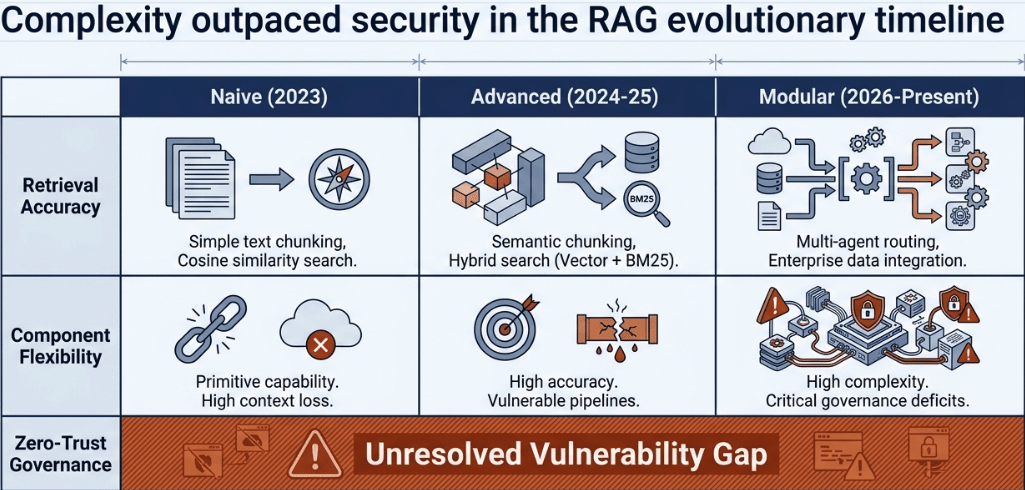
1.1 Phase 1: Naive RAG (Early 2023)
The archetype of RAG operated on a straightforward, linear pipeline. Documents were sliced into rigid, fixed-size chunks, converted into vector representations via open-source embedding models, and hosted within a vector database. Upon receiving a user query, the system executed a simple Cosine Similarity search, pulling the top $K$ context chunks and feeding them blindly into the LLM prompt window.
While exceptionally easy to prototype, Naive RAG suffered from massive systemic flaws. It frequently led to severed semantic contexts, loss of critical nuances across chunk boundaries, and an influx of redundant or irrelevant information. This bloated the prompt window, wasted token costs, and heavily triggered LLM hallucinations.
1.2 Phase 2: Advanced RAG (2024–2025)
To extract high precision and granular relevance, engineers introduced sophisticated pre-retrieval and post-retrieval optimizations into the architecture.
- Document Structuring and Parsing: Fixed-size chunking was deprecated in favor of Semantic Chunking, preserving structural hierarchies, metadata tables, hyperlinks, and document headers.
- Hybrid Search Integration: A acknowledging the mathematical blind spots of dense vector retrieval, architectures fused semantic search with traditional lexical matching (BM25) to preserve exact keyword and product code matching. These disparate result streams were unified using Reciprocal Rank Fusion ($RRF$) algorithms.
- Cross-Encoder Reranking: The bloated candidate pool from the primary search stage was down-selected via high-precision, lightweight Cross-Encoder models. This post-retrieval filtering ensured that only the absolute highest-scoring, context-justified documents reached the LLM prompt, dropping hallucination rates exponentially.
1.3 Phase 3: Modular RAG and Data Governance (2026 Present)
Modern RAG architectures have evolved far beyond a static search-and-generate loop. Today’s systems employ Modular RAG, incorporating dynamic query routing, iterative multi-agent re-retrieval loops, and automated prompt-tuning pipelines.
As enterprise-grade data integration reaches its peak, the primary metrics for RAG success are no longer just speed and accuracy; they are rigorous data governance, cryptographic multi-tenancy isolation, granular access permissions, and real-time data lineage auditing.
2. Analyzing the Open-Source Heavyweight: LangChain
Within the global artificial intelligence ecosystem, LangChain stands as the most dominant, widely adopted orchestration framework for RAG applications. Moving through 2025 and solidifying its position in 2026, LangChain has transitioned from a basic helper library into a sprawling enterprise platform powered by LangGraph and LangSmith.
2.1 Architectural Strengths and Core Value
LangChain’s primary appeal lies in its clean abstraction of LLM application components, enabling developers to stitch together complex behaviors through standardized interfaces.
- Modular Component Abstraction: It offers an exhaustive ecosystem of Document Loaders (PyPDF, Notion, Confluence), Vector Store integrations (Qdrant, Chroma, Pinecone), and LLM connectors (OpenAI, Anthropic, Google Gemini), all switchable with minimal code changes.
- LCEL (LangChain Expression Language): A declarative syntax that simplifies the construction of production pipelines, natively supporting asynchronous processing, real-time streaming, and robust fallback configurations.
- State-Driven Agentic Programming via LangGraph: It shifts RAG from a deterministic pipeline into an agentic graph. This allows loops where an AI agent can evaluate the quality of its retrieved context, determine if information is missing, and autonomously loop back to re-query the database before generating an answer.
2.2 Enterprise Vulnerabilities and the Governance Vacuum
Despite its incredible velocity for prototyping and workflow design, LangChain introduces severe governance and security liabilities when introduced to highly regulated enterprise environments.
- Lack of Native De-identification Engines: The framework lacks integrated, high-throughput control layers to intercept data inflight. It cannot dynamically detect and tokenize Personally Identifiable Information (PII) like national ID numbers, banking credentials, or emails before sending data across third-party LLM APIs.
- Absence of Rigid Multi-Tenant Hardening: In multi-tenant SaaS environments, enforcing pre-filtering (restricting vector queries before database execution based on user tenant constraints) is left entirely to the developer’s application logic. LangChain does not architecturally mandate or guarantee tenant isolation at the framework level.
- Security Layer Latency Overhead: Attempting to manually patch third-party security proxies or interceptor loops into LangChain workflows splits the pipeline state, causing execution paths to fragment and driving latency (p95) past acceptable SLAs.
3. Domain-Specific and Specialized RAG Trends
As the marketplace matures, generic document retrieval is giving way to highly specialized RAG architectures tailored for specific enterprise data structures.
3.1 GraphRAG (Knowledge Graph-Powered RAG)
Championed by enterprise innovators, GraphRAG moves past basic text similarity by extracting entities and mapping their explicit dependencies into a centralized Knowledge Graph.
- Core Value: It excels at synthesizing macro-level topics across massive document sets and handling complex multi-hop queries, such as: “What are the revenue trends of corporate subsidiaries owned by the cousins of Company A’s executive board?”
3.2 Hybrid Structured-Unstructured RAG (SQL/Pandas RAG)
This model bridges the gap between unstructured manuals and tabular corporate repositories, such as factory logs, financial ledger databases, and ERP transactional pools.
- Core Value: Intelligent routers evaluate natural language queries dynamically, splitting the workload between relational SQL queries (structured data) and vector store lookups (unstructured data), blending the responses into a coherent analytical narrative.
3.3 Airtight Air-Gapped RAG (On-Premise RAG)
Rapidly gaining ground across public sectors, defense networks, and sovereign banking systems, this architecture completely cuts out dependency on external APIs.
- Core Value: It hosts highly compressed, fine-tuned open-source LLMs (such as Llama 3 or Mistral variants) directly on local bare-metal or private cloud infrastructures, keeping all data completely inside the enterprise perimeter.
4. [Bastion-RAG] Security RAG Governance Framework Design
Differing from generalized orchestration frameworks like LangChain, Bastion-RAG is engineered from the ground up as a high-performance security governance framework for enterprise RAG pipelines. Candidly speaking, the framework is currently in its initial phase. Because I began designing this while deeply exploring the mechanics of LLM security, the current implementation leans heavily toward an educational and architectural proof-of-concept. Some might see that as a limitation, but it ensures every security boundary is transparent and audit-ready.
Bastion-RAG implements a symmetrical defense architecture that secures both the Input Path and the Output Path concurrently, maintaining sub-millisecond processing efficiency.
                    [ Bastion-RAG Symmetrical Pipeline ]

User Input ──▶[Bastion-RAG 1: Sentinel-IN] ──▶ [Bastion-RAG 2: Vault-Phase1] ──▶
                                                                             │
                                                         [Bastion-RAG 3: Navigator]
                                                                             │
                                                           [Bastion-RAG 4: Anchor]
                                                                             │
Safe Response ◀─[Bastion-RAG 1: Sentinel-OUT]◀─[Bastion-RAG 2: Vault-Phase2]◀─ LLM
[Bastion-RAG 1 — Sentinel] Symmetrical Validation Gateway
- Design Intent: Operating at the perimeter of the RAG application, this module forms the first and last line of defense, scanning incoming queries to block malicious exploits and validating outgoing generated text to guarantee compliance.
- Technical Specifications:
- Prompt Injection Defense (Sentinel-IN): Intercepts system-override commands, jailbreak strings, and indirect prompt injection attempts hidden within external documents. Powered by a high-performance Go-based regex and heuristic scoring engine, it flags and blocks threats within 0.3 ms.
- Output Content Filtering (Sentinel-OUT): Evaluates the raw LLM output against strict data policies, filtering profanity, toxic content, and corporate secrets (such as internal system paths or leaked API keys) via real-time redacting or masking.
[Bastion-RAG 2 — Vault] Zero-Trust Privacy Shield
- Design Intent: Ensures that upstream LLMs and third-party AI APIs never ingest raw enterprise PII, while stopping cross-tenant data contamination in shared cloud infrastructures.
- Technical Specifications:
- Cryptographic Multi-Tenancy: Leverages tenant-specific encryption data keys tied to a centralized Key Management Service (KMS). This ensures user interactions from Tenant A are cryptographically segregated from Tenant B’s data domain.
- Deterministic Tokenization: Intercepts raw PII strings and maps them to structural, context-preserving placeholders (e.g.,
[PERSON_a3f2c1]). Because the tokenization is deterministic, the LLM retains full context for entity relationships across sentences. When the final response is prepared, an Open Policy Agent (OPA) engine handles selective decryption based on user access clearing levels.
[Bastion-RAG 3 — Navigator] Tenant-Isolated Hybrid Search
- Design Intent: Controls access to the enterprise vector space, ensuring that unauthorized or restricted documents are completely excluded from the search candidate selection loop.
- Technical Specifications:
- Pre-Filtering Isolation: Unlike weak post-filtering patterns that trim unauthorized documents after a database search, Navigator forces tenant identifiers and user role categories directly into the vector query parameters before execution against the Qdrant database.
- Logical Partitioning: Organizes corporate data into separate, permission-mapped collections (e.g., Public, Marketing, Restrictive HR/Finance). It executes a unified hybrid search utilizing dense vector representations (BGE-M3) and sparse keyword parameters, finishing with an in-process Cross-Encoder reranking routine for maximum accuracy.
[Bastion-RAG 4 — Anchor] Mathematical Embedding Security
- Design Intent: Counteracts advanced security vectors like Embedding Inversion Attacks—where attackers steal raw floating-point vectors from a database to mathematically reconstruct the original source sentences—and acts as an AI ethics watchdog.
- Technical Specifications:
- Differential Noise Injection: Applies controlled Gaussian or Laplacian noise perturbations directly to embedding vectors during indexing and query operations. This maintains vector search similarity scores and recall stability, while introducing enough mathematical entropy to break reverse-engineering text-reconstruction algorithms.
- Embedding Model Bias Verification: Utilizes the Word Embedding Association Test ($WEAT$) algorithm to run real-time statistical profiling on internal vector spaces and LLM generation metadata, throwing compliance alerts if demographic, gender, or racial biases cross pre-set thresholds.
[Bastion-RAG 5 — Tracker] Non-Invasive Observability Engine
- Design Intent: Logs, visualizes, and traces the life cycle of every payload across the security wrapper without touching or slowing down the primary data path.
- Technical Specifications:
- Distributed Data Lineage Tracing: Built on a decoupled NATS event bus model, Tracker ingests asynchronous security events from all running modules. By binding a cryptographic
trace_idto each transaction, it creates tamper-proof audit trails and interactive graphs documenting every single masking, routing, and access check decision. - Multi-Layer Honey-Token Intrusion Detection: Scatters fake, decoy document records (e.g., fictional customer profiles, fake system access tokens) deep inside the document collection. Because legitimate users will never query these decoys, any retrieval signature instantly flags a corporate data breach, triggering instant session termination and incident workflows.
- Distributed Data Lineage Tracing: Built on a decoupled NATS event bus model, Tracker ingests asynchronous security events from all running modules. By binding a cryptographic
[Bastion-RAG Demo] Interactive Security Scenario Replay Mode
- Design Intent: An integrated dashboard designed to show the immediate risk-mitigation value of the governance layer under real-world stress conditions.
- Technical Specifications: Simulates 8 real-world cyber-attack patterns against an enterprise RAG system, including indirect prompt injections, cross-tenant privilege escalation attempts, and bulk PII exfiltration. A React-based visualization interface maps out exactly how Bastion-RAG identifies, tracks, and isolates each security event in real time.
5. Summary and Outlook
The Bastion-RAG framework is engineered as a deterministic security roadmap designed to enforce data governance boundaries within enterprise environments without compromising retrieval pipeline accuracy. The core architecture provides a verifiable, compliance-aligned data governance foundation suitable for deployment within highly regulated industry frameworks under CISO and Principal AI Architect oversight.
While the initial alpha iteration functions as a foundational reference implementation for security engineering analysis, the underlying polyglot topology utilizes distinct, language-specific runtime environments to balance execution velocity with ecosystem compatibility. Low-latency perimeter validation and network-layer interceptors are handled via Go implementations, while complex mathematical operations and in-process machine learning routines are isolated within Python-based modules.
This decoupling of responsibilities into modular, composable components addresses enterprise infrastructure constraints, establishing a structured security model designed to maintain operational isolation and strict data controls across distributed enterprise systems.